The 2026 academic year has ushered in a new era of “Hyper-Personalized Learning.” For American college students, the landscape is no longer just about attending lectures and taking notes; it’s about managing a complex digital ecosystem. With 92% of US universities now fully integrating digital learning platforms and AI-driven curriculum, the barrier between “studying” and “tech management” has officially dissolved.
However, this digital shift brings a heavy cost. Recent data from the 2026 Thriving College Student Index reveals that 45% of students identify anxiety and chronic stress as their primary hurdles this year. The pressure to maintain a high GPA while navigating a labor market transformed by AI has made time the most valuable currency on campus. To survive, students are moving away from the “grind culture” of the past and toward a strategy of academic delegation and sophisticated toolkits.
As the workload reaches a tipping point, many are realizing that they cannot do it all alone. In a survey by Campus Safety Magazine, nearly 43% of students expressed a need for more flexibility in coursework and deadlines. This has led to a surge in students seeking professional support to pay someone to do my homework for secondary subjects, allowing them to focus their energy on core major requirements and high-stakes internships that define their post-grad ROI.


The 2026 Essential Toolkit: A Breakdown
To navigate this year effectively, your toolkit needs to address three pillars: Organization, Research, and Execution.
1. AI Thought Partners and Deep Research
In 2026, generic chatbots are out. Precision tools like NotebookLM and Gemini’s Deep Research are the new standard. These tools allow you to upload up to 1,500 pages of specific course material to create a “grounded” AI that only answers based on your professor’s syllabus and textbooks.
- Why it matters: It prevents “hallucinations” and ensures your study sessions are 100% relevant to your specific exams.
2. Advanced Reference Management
With academic integrity being more scrutinized than ever due to GenAI, tools like Zotero and Mendeley have become non-negotiable.
- Data Insight: Research shows that students using automated citation managers reduce manual errors by 70%, significantly lowering the risk of accidental plagiarism.
3. Strategic Academic Delegation
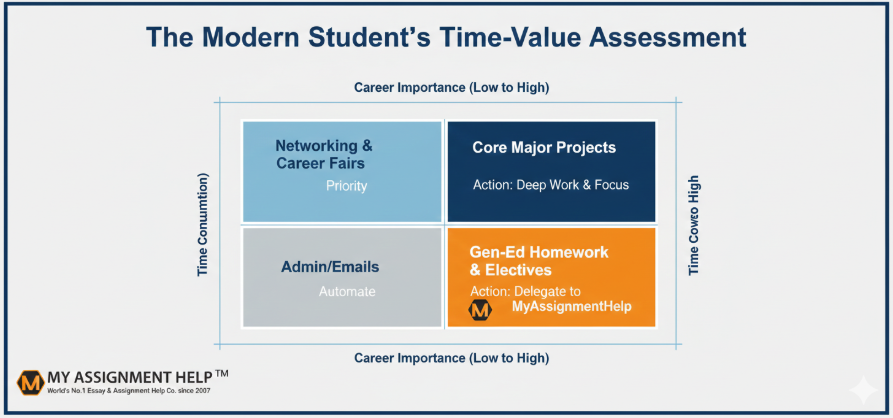
The most successful students in 2026 are those who act like project managers. They identify which tasks require their unique intellectual input and which are “busy work.” When a student decides to make my assignment through a professional service, they aren’t just getting a paper—they are buying back 10–15 hours of their week to invest in networking or mental health.
Data-Driven Insights: Why “Working Harder” is Failing
The old mantra of “pulling an all-nighter” is statistically proven to be counterproductive. A 2025 longitudinal study by Stanford University found that untreated academic stress and burnout can lower a student’s GPA by up to 0.5 points per semester.
| Challenge | Impact on Students (2026) | Tool/Solution |
| Information Overload | 62% increase in knowledge gaps | AI Thought Partners |
| Academic Burnout | 49% considered “stopping out” | Professional Delegation |
| Integrity Concerns | 72% of teachers are wary of AI | Human-led Writing Services |
Key Takeaways for the 2026 Student
- Audit Your Time: If a task doesn’t contribute to your long-term career skill set, delegate it.
- Use Grounded AI: Only use AI tools that allow you to cite your own sources.
- Prioritize Well-being: 57% of “thriving” students report that social connection is their biggest stress-reliever—don’t sacrifice it for a history elective paper.
See also: How Technology Is Reshaping the Real Estate Landscape
Frequently Asked Questions (FAQ)
Q: Is using a homework service considered “cheating” in 2026?
A: It is viewed as a form of supplemental tutoring. Just as a student would hire a private tutor to explain a concept, using a professional service to provide a model assignment helps students understand the structural and research requirements of high-level academic writing.
Q: How do I know which AI tools are safe for my university data?
A: Stick to “Enterprise” or “Education” versions of tools like Google Workspace or Microsoft 365, which have higher data privacy standards and keep your uploads within the university domain.
Q: What is the biggest trend in US higher education this year?
A: The shift toward ROI-driven degrees. Universities are now being measured by career placement rather than just graduation rates, making internships and practical skills more important than ever.
Author Bio
Dr. Aris Thorne is a Senior Academic Consultant at MyAssignmentHelp. With over 12 years of experience in the US higher education sector, Dr. Thorne specializes in student productivity and the integration of EdTech in modern curricula. He has helped thousands of students move from “struggling” to “thriving” by teaching them the art of strategic academic management.
References:
- ETS (2026). “7 Trends That Will Reshape Higher Education.”
- Healthy Minds Study (2025). “National Student Mental Health Survey Results.”
- OECD (2026). “Digital Education Outlook: GenAI as a Pedagogical Partner.”
- Stanford University (2025). “Longitudinal Study on Academic Stress and GPA Outcomes.